Residents of Panganiban here and in the other parts of the world are in the midst of a fund-raising campaign for the rectory construction project which was launched in late July. Read more...
Friday, November 7, 2008

Wednesday, November 5, 2008
Town Fights Quarrying For Iron
BAGAMANOC, Catanduanes – Late in October, opposition from residents and the Catholic clergy in this province has prompted the Department of Environment and Natural Resources Mines and Geosciences Bureau (DENR-MGB) to issue a cease-and-desist order (CDO) against the magnetite (iron ore) extraction activities of Chinese firm Shun Fong Transport Co.
The CDO was based on findings of DENR-MGB investigators, who after conducting interviews with residents and company workers, determined that Shun Fong was engaged in the illegal extraction of black sand, locally known as “amargaja”, from Babaguan Bay along the coast of the two towns of Panganiban and Bagamanoc towns, located about 60 kilometers from the capital town of Virac.
The controversy erupted in the first week of September when concerned Bagamanoc residents noted the arrival of the Chinese firm, which began constructing a barge on the beach just a hundred meters away from the municipal hall.
They grew alarmed when they saw that the boat was going to be equipped with a suction pump and a magnetite processor, which workers said would be used to suck black sand offshore.
Wave erosion
Days after the arrival of Shun Fong in their community, I-Care Bagamanoc, a nongovernment organization led by Fr. Juan Tejerero held a public assembly at the parish church where municipal officials led by Mayor Odilon Pascua were roundly criticized for allowing the mining activity despite the dangers posed to the environment.
During the last decades, the unprotected shoreline of Bagamanoc has been receding due to wave erosion, with the poblacion losing two streets to the sea so far. Current and past municipal administrations have been trying to extend a sea wall but the dearth of funds has prevented its full completion.
In an interview at his capitol office, Gov. Joseph Cua confirmed he has invited Henry Sy of Shun Fong Transport (with offices located in Greenhills, San Juan) to conduct preliminary reclamation work for planned reclamation projects in some coastal areas of the province.
The projects would pave the way for the construction of commercial and fishing ports in the municipalities where it is feasible.
Citing budgetary constraints of the provincial government, Cua said he asked Shun Fong to conduct surveys at no cost to the province, to determine the depth of the shoreline, the total area of the reclamation site, and the volume of earth fill needed.
He cited Bagamanoc and Panganiban towns as the priority sites.
He added that the firm could have been in the process of conducting sedimentary sampling of the black sand, which is a raw material used for the production of metal, when the opposition to its activities grew.
He said that in magnetite mining, wherein black sand is siphoned off the sea floor and the magnetite removed by a magnetic separator aboard a vessel, only 6 percent of the sand is taken, with the 94 percent returned to the sea floor.
This unwanted quantity, the governor said, could be used in reclaiming the considerable land area that has been lost by Bagamanoc town to the advancing sea.
In an interview with the Inquirer early in October, Mayor Odilon Pascua shared the governor’s view and stressed that no magnetite extraction occurred on the shores of the coastal town.
The Sangguniang Bayan, headed by Vice Mayor Juan Velchez Jr., however, was opposed to Cua and Pascua’s views and asked Pascua to stop any illegal mining activity.
Velchez affirmed that as early as Sept. 8, they had invited the Chinese firm to shed light on the issue.
Pascua told the municipal officials that he had already relayed the request to Cua, who asked for some time to allow Shun Fong to finish construction of its barge.
At the end of September, Shun Fong towed its barge to Panganiban town and began extracting black sand from the shallow sea of Babaguan Bay prompting local fishermen to complain that the activity resulted in turbid waters and harmed fishpens in the area.
The town mayor, Gregorio Angeles, said he would not oppose magnetite mining within the territorial jurisdiction of the town, provided it is done offshore.
In an interview, he said the Chinese group is just conducting a survey of possible magnetite deposits before undertaking any mining activity.
In case mining takes place offshore, he added that the sand washed out of the magnetite separation process could be used to reclaim part of Panganiban’s shallow shore for the proposed commercial port.
Open letter
The views of the local government officials on the mining activities of Shun Fong, however, did not sit well with the Catholic leadership and clergy in the province.
After two days of intensive discussion, Bishop Manolo A. delos Santos and 29 priests of the Diocese of Virac wrote an open letter addressed to the public officials.
The letter demanded immediate cessation of the mining activity off the shores of Panganiban and Bagamanoc pending a full-blown investigation and public consultation on the already controversial issue.
Critics have brought their case to cyberspace via Youtube where a video dubbed “Amargaha” was uploaded while a group of Panganiban residents citing environmental concerns and transparency placed a half page ad in a local newspaper.
The clergy asked for pertinent information, especially on the possible environmental and socio-economic repercussions of the mining activity of Shun Fong.
They demanded that the results of the probe be made open to the stakeholders at the earliest possible time.
The bishop himself, accompanied by other parish priests, traveled to the company’s magnetite processing site in Barangay San Antonio in Panganiban last Oct. 25 to check the claims made by I-Care Bagamanoc.
Insiders said the bishop would bring a copy of the open letter to Malacañang to personally appeal for the intervention of President Macapagal-Arroyo.
When it received the manifesto of the clergy, the Sangguniang Panlalawigan promptly referred the matter to the Committee on Environment and Natural Resources headed by provincial board member Francisco “Jun” Camano, Jr.
Camano said he has yet to have a copy of the DENR order but will proceed with the investigation of the controversy anytime this November.
The local Catholic clergy had requested a copy of the DENR-EMB’s CDO order against Shun Fong from the provincial capitol but were told only that it was in the hands of special projects consultant Cham de Garcellanosa.
Capitol employees said the consultant had worked for the Lafayette mining company in Rapu-rapu, Albay before he was employed at the capitol.
In a chance interview at the provincial capitol, Shun Fong project coordinator Arnie Mesia said that in the aftermath of the controversy and CDO order, the company would lease a local boat to tow the barge used in the extraction to Virac and then to Sorsogon where he said local people are engaged in small-scale on-shore magnetite mining. However, rough seas have stranded the barge in Panganiban.
Mesa said the company would probably apply for a permit to explore and subsequently extract magnetite from a mountain-sized deposit located along a river somewhere between Barangays Hinipaan and Bacak.
By Fernan Gianan
Philippine Daily Inquirer
First Posted 01:28:00 11/06/2008
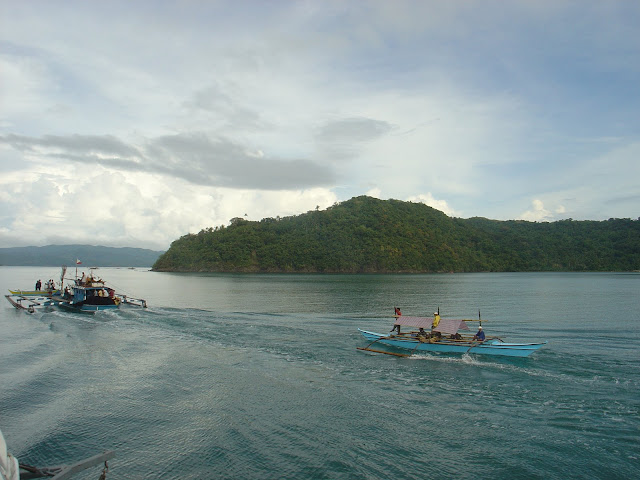 |
| Bagamanoc |
The controversy erupted in the first week of September when concerned Bagamanoc residents noted the arrival of the Chinese firm, which began constructing a barge on the beach just a hundred meters away from the municipal hall.
They grew alarmed when they saw that the boat was going to be equipped with a suction pump and a magnetite processor, which workers said would be used to suck black sand offshore.
Wave erosion
 |
| Bagamanoc seawall |
During the last decades, the unprotected shoreline of Bagamanoc has been receding due to wave erosion, with the poblacion losing two streets to the sea so far. Current and past municipal administrations have been trying to extend a sea wall but the dearth of funds has prevented its full completion.
In an interview at his capitol office, Gov. Joseph Cua confirmed he has invited Henry Sy of Shun Fong Transport (with offices located in Greenhills, San Juan) to conduct preliminary reclamation work for planned reclamation projects in some coastal areas of the province.
The projects would pave the way for the construction of commercial and fishing ports in the municipalities where it is feasible.
Citing budgetary constraints of the provincial government, Cua said he asked Shun Fong to conduct surveys at no cost to the province, to determine the depth of the shoreline, the total area of the reclamation site, and the volume of earth fill needed.
He cited Bagamanoc and Panganiban towns as the priority sites.
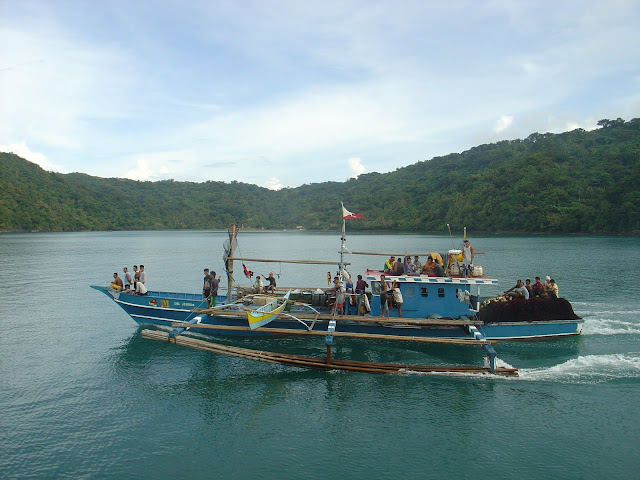 |
| Boat load of iron ore |
He said that in magnetite mining, wherein black sand is siphoned off the sea floor and the magnetite removed by a magnetic separator aboard a vessel, only 6 percent of the sand is taken, with the 94 percent returned to the sea floor.
This unwanted quantity, the governor said, could be used in reclaiming the considerable land area that has been lost by Bagamanoc town to the advancing sea.
In an interview with the Inquirer early in October, Mayor Odilon Pascua shared the governor’s view and stressed that no magnetite extraction occurred on the shores of the coastal town.
The Sangguniang Bayan, headed by Vice Mayor Juan Velchez Jr., however, was opposed to Cua and Pascua’s views and asked Pascua to stop any illegal mining activity.
Velchez affirmed that as early as Sept. 8, they had invited the Chinese firm to shed light on the issue.
Pascua told the municipal officials that he had already relayed the request to Cua, who asked for some time to allow Shun Fong to finish construction of its barge.
At the end of September, Shun Fong towed its barge to Panganiban town and began extracting black sand from the shallow sea of Babaguan Bay prompting local fishermen to complain that the activity resulted in turbid waters and harmed fishpens in the area.
The town mayor, Gregorio Angeles, said he would not oppose magnetite mining within the territorial jurisdiction of the town, provided it is done offshore.
In an interview, he said the Chinese group is just conducting a survey of possible magnetite deposits before undertaking any mining activity.
In case mining takes place offshore, he added that the sand washed out of the magnetite separation process could be used to reclaim part of Panganiban’s shallow shore for the proposed commercial port.
Open letter
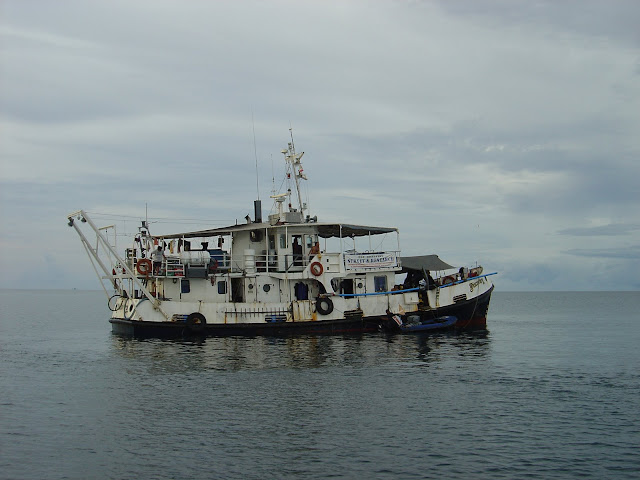 |
| Historical and Nautical Archaeology Foundation (HNAF) |
After two days of intensive discussion, Bishop Manolo A. delos Santos and 29 priests of the Diocese of Virac wrote an open letter addressed to the public officials.
The letter demanded immediate cessation of the mining activity off the shores of Panganiban and Bagamanoc pending a full-blown investigation and public consultation on the already controversial issue.
Critics have brought their case to cyberspace via Youtube where a video dubbed “Amargaha” was uploaded while a group of Panganiban residents citing environmental concerns and transparency placed a half page ad in a local newspaper.
The clergy asked for pertinent information, especially on the possible environmental and socio-economic repercussions of the mining activity of Shun Fong.
They demanded that the results of the probe be made open to the stakeholders at the earliest possible time.
The bishop himself, accompanied by other parish priests, traveled to the company’s magnetite processing site in Barangay San Antonio in Panganiban last Oct. 25 to check the claims made by I-Care Bagamanoc.
Insiders said the bishop would bring a copy of the open letter to Malacañang to personally appeal for the intervention of President Macapagal-Arroyo.
When it received the manifesto of the clergy, the Sangguniang Panlalawigan promptly referred the matter to the Committee on Environment and Natural Resources headed by provincial board member Francisco “Jun” Camano, Jr.
Camano said he has yet to have a copy of the DENR order but will proceed with the investigation of the controversy anytime this November.
The local Catholic clergy had requested a copy of the DENR-EMB’s CDO order against Shun Fong from the provincial capitol but were told only that it was in the hands of special projects consultant Cham de Garcellanosa.
Capitol employees said the consultant had worked for the Lafayette mining company in Rapu-rapu, Albay before he was employed at the capitol.
In a chance interview at the provincial capitol, Shun Fong project coordinator Arnie Mesia said that in the aftermath of the controversy and CDO order, the company would lease a local boat to tow the barge used in the extraction to Virac and then to Sorsogon where he said local people are engaged in small-scale on-shore magnetite mining. However, rough seas have stranded the barge in Panganiban.
Mesa said the company would probably apply for a permit to explore and subsequently extract magnetite from a mountain-sized deposit located along a river somewhere between Barangays Hinipaan and Bacak.
By Fernan Gianan
Philippine Daily Inquirer
First Posted 01:28:00 11/06/2008
Monday, November 3, 2008
Japanese Retirement Village in the Philippines
The Philippines is being eyed as a prime medical, health care and retirement destination for Japanese. According to studies, one out of four people in Japan will be aged 65 by 2020, from one out of six in 2000. Now is the best time to set up the retirement village for Japanese as baby boomers will start retiring in 2007.
Several notable Japanese companies have already initiated building medical and retirement havens in the Philippines. These include Sanyo Emeritus Co. Ltd., a joint venture between Sanyo Electric and Emeritus Corp. of Seattle, which provides "assisted living" services in the US and Canada; as well as Tokushukai Medical Corp., Japan's largest hospital chain, which is putting up a $100 million, 1000-bed hospital in the Philippines, targeting elderly Japanese citizens.
 The Philippines is highly regarded because of its mild climate enjoyed by Japanese, its close proximity to Japan, the high quality of the Philippines' healthcare workforce, and the significantly lower cost of living.
Cost of living in Japan is 60 percent higher than in the Philippines. This means the retirees can enjoy their pensions more than those staying in Japan. By moving to the Philippines, they can spend half of what they would pay for rent at home in Japan and live in seaside resort mansions with guards, swimming pools, tennis courts and spacious bedrooms.
We are currently looking at developing our 100-hectare premium property into an exclusive Japanese retirement village. The property is located right beside a premier golf and leisure estate having four (4) 18-hole championship golf courses designed by the world renowned golfers, Isao Aoki, Andy Dye, Nick Faldo, and Greg Norman and is frequented by many Japanese executives and businessmen.
The prime property is only 15 minutes away from two major commercial malls as well as leading universities. It is conveniently located midway between Makati, the financial and urban center of the Philippines, and popular tourist destinations such as Tagaytay, Batangas and Laguna. Retirees will be half an hour away from the cool highlands of Tagaytay which overlooks the famous Taal Volcano and Taal Lake; an hour away from the beaches and famous diving spots of Batangas; as well as the mountains, hot springs, and lakes of Laguna.
We envision the Japanese retirement village to be a place where retirees can keep an active, meaningful, and fruitful lifestyle with modern houses and amenities, sports and recreational facilities, medical, health and care-giving services, educational, training and business centers. The retirees will be able to participate in many programs and activities such as gardening, cooking, ballroom dancing, pottery making, painting and other activities.
We are looking for a Japanese partner who would like to go into a joint venture to develop our property into an exclusive Japanese retirement village. We are looking for a partner who can handle the sales and marketing of the project in Japan and who would provide conceptual designs and specifications according to the preferences of the Japanese market.
Interested companies/investors may send their letter of intent and company profile to us. Please see "More Info." for our company profile and contact details.
Source: Japan External Trade Organization
RELATED LINKS:
Several notable Japanese companies have already initiated building medical and retirement havens in the Philippines. These include Sanyo Emeritus Co. Ltd., a joint venture between Sanyo Electric and Emeritus Corp. of Seattle, which provides "assisted living" services in the US and Canada; as well as Tokushukai Medical Corp., Japan's largest hospital chain, which is putting up a $100 million, 1000-bed hospital in the Philippines, targeting elderly Japanese citizens.
 The Philippines is highly regarded because of its mild climate enjoyed by Japanese, its close proximity to Japan, the high quality of the Philippines' healthcare workforce, and the significantly lower cost of living.
Cost of living in Japan is 60 percent higher than in the Philippines. This means the retirees can enjoy their pensions more than those staying in Japan. By moving to the Philippines, they can spend half of what they would pay for rent at home in Japan and live in seaside resort mansions with guards, swimming pools, tennis courts and spacious bedrooms.
We are currently looking at developing our 100-hectare premium property into an exclusive Japanese retirement village. The property is located right beside a premier golf and leisure estate having four (4) 18-hole championship golf courses designed by the world renowned golfers, Isao Aoki, Andy Dye, Nick Faldo, and Greg Norman and is frequented by many Japanese executives and businessmen.
The prime property is only 15 minutes away from two major commercial malls as well as leading universities. It is conveniently located midway between Makati, the financial and urban center of the Philippines, and popular tourist destinations such as Tagaytay, Batangas and Laguna. Retirees will be half an hour away from the cool highlands of Tagaytay which overlooks the famous Taal Volcano and Taal Lake; an hour away from the beaches and famous diving spots of Batangas; as well as the mountains, hot springs, and lakes of Laguna.
We envision the Japanese retirement village to be a place where retirees can keep an active, meaningful, and fruitful lifestyle with modern houses and amenities, sports and recreational facilities, medical, health and care-giving services, educational, training and business centers. The retirees will be able to participate in many programs and activities such as gardening, cooking, ballroom dancing, pottery making, painting and other activities.
We are looking for a Japanese partner who would like to go into a joint venture to develop our property into an exclusive Japanese retirement village. We are looking for a partner who can handle the sales and marketing of the project in Japan and who would provide conceptual designs and specifications according to the preferences of the Japanese market.
Interested companies/investors may send their letter of intent and company profile to us. Please see "More Info." for our company profile and contact details.
Source: Japan External Trade Organization
RELATED LINKS:
- About Geotourism - Geotourism is defined as tourism that sustains or enhances the geographical character of a place—its environment, culture, aesthetics, heritage, and the well-being of its residents...
- Duplicating Puerto Galera - Puerto Galera is a 3rd class municipality in the province of Oriental Mindoro, Philippines. It is the northwesternmost municipality in Oriental Mindoro...
- Smiling At Life In Catanduanes - Peaceful, remote, laid back and rustic. Inhabitants of this small communities often are relatives and have kins working overseas or perhaps migrated in other places...
Sunday, November 2, 2008
Boses Nin Catandungan
If I remember it right, Musika Tanog Bikol was a fund raising drive for typhoon victims in Catanduanes. I was still in college back then, the first concert composed of Catandunganon talents at the then popular hip venue in Greenhills, San Juan.
RELATED LINKS:
RELATED LINKS:
- Is There an English Equivalent Word for Pantomina? - Pantomine is it?
- Usual Sights - Take a photo tour of Catanduanes.
- Must See Sights in Catanduanes - What makes the island unique? Check this out.
Saturday, November 1, 2008
Smiling At Life In Catanduanes
Possibly, many are wondering why am I posting maps of not often heard remote villages in our island. Peaceful, remote, laid back and rustic. Inhabitants of this small communities often are relatives and have kins working overseas or perhaps migrated in other places.
 What makes these characteristics interesting to me is, these villages and municipalities can be a potential retirement destination for both foreign or local retirees, once promoted and develop as a retiree's haven. It is projected that this retirement program would be a US$40B industry by 2015.
Retirees often are in the twilight of their years and would pose no harm to our security, people and environment. And could be of help in our community by hiring caregivers, drivers, gardeners and househelps. They would not crave for expensive and heavily calorie laden foods, but instead, more on organically grown fresh vegetables and fishes, to which our friendly farmers and fishers can provide.
Maybe, there are some former residents who migrated and wishing to start smiling at life in Catanduanes.
RELATED ARTICLES:
What makes these characteristics interesting to me is, these villages and municipalities can be a potential retirement destination for both foreign or local retirees, once promoted and develop as a retiree's haven. It is projected that this retirement program would be a US$40B industry by 2015.Retirees often are in the twilight of their years and would pose no harm to our security, people and environment. And could be of help in our community by hiring caregivers, drivers, gardeners and househelps. They would not crave for expensive and heavily calorie laden foods, but instead, more on organically grown fresh vegetables and fishes, to which our friendly farmers and fishers can provide.
Maybe, there are some former residents who migrated and wishing to start smiling at life in Catanduanes.
RELATED ARTICLES:
- Barangay Manambrag - This is Manambrag, a barangay of San Andres (Calolbon) Catanduanes. I never gone to this place yet but it looks like a small peaceful village. According to August 2007 Census, she has an overall population of 2,582.
- The PRA Business Guide - As a general rule, anyone regardless of nationality may invest in the Philippines. However, foreign nationals enrolled in the Retirement Program are, under the Authority’s existing Implementing Investment Guidelines, permitted after a holding period of 30 days
Subscribe to:
Posts (Atom)