Wednesday, February 25, 2009

The Catanduanes Circumferential Road Improvement Project (CCRIP)

October 22, 2007: Inaugurated was the 79.818-kilometer road stretching from San Andres to Viga and five (5) bridges, which are components of the fourth phase of the Arterial Road Links Development Project.

Pagsangahan bridge
Total project cost amounted to approximately 1.1 billion pesos and was financed by Official Development Assistance from the Government of Japan. This road section is the biggest in the planned 200-kilometer Catanduanes Circumferential Road Improvement Project.
  • CP I: Codon-San Andres-Virac-Viga Road (79.848 kms.) - completed
  • CP II: Viga-Bagamanoc Road (9.985 kms.) - in progress
  • CP III: Bagamanoc-Pandan Road (48.106 kms.) - in progress
  • CP IV: Pandan-Caramoran-Codon (62.221 kms.) - in progress
The second phase of the multibillion-peso Catanduanes Circumferential Road Improvement Project (CCRIP) has been included in the 28th Yen Loan Package of the Japanese government.

Target Completion: 2010

RELATED LINKS:
  • The Way We Were - State of circumferential road to Payo from Virac during its construction phase.

Tuesday, February 24, 2009

Rain Averages 240 Days in a Year

I was searching for a 5-year period updated rainfall chart for Catanduanes because I needed one to support my decision to hold a project. A friend once told me, that our island was one time a trivia question on a popular T.V. noontime show, where rainfall averages 240 days in a year.

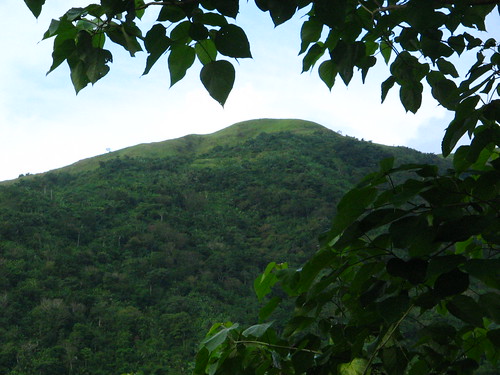
Bato mountain.Here are some interesting facts I found online:

www.worldwildlife.org/

The southeastern portions of Luzon in Polillo and Catanduanes Islands have no dry season but do have a period of increased rainfall from May to January. Northwestern Luzon has two distinct seasons, being wet from May to October and dry November to April.

source: http://www.worldwildlife.org/wildworld/profiles/terrestrial/im/im0123_full.html

Catanduanes Tribune, 22 January 2009 report:
On the other hand, the Baras station recorded a maximum of 244 millimeters of rain during the period from 6 P.M. of Jan. 6 to 2:35 A.M. of Jan. 7 when a local thunderstorm caused flashfloods and landslides in Bato, Baras, San Miguel, Viga, Panganiban, Bagamanoc and Gigmoto. Virac had a much lesser volume of precipitation at 130 millimeters, but still higher than the monthly average of 65 mm and maximum of 120 mm for the entire island, Pantino added.

source: http://www.catanduanestribune.com/NewsArticle/Detail.aspx?newsID=5050

www.wikipedia.org/ Typhoon Unding (2004):


Photo Sharing
There was an area of extreme rainfall measuring possibly 40 inches (1,000 mm) just east off the coast of southern Luzon. Much of southern Luzon and other portions of central Philippines received rainfall between 10 to 20 inches (510 mm). Catanduanes and extreme southeastern Luzon might have been blanketed in as much as 35 inches (890 mm) of rain though. Naga City only received a total of 8.26 inches (210 mm) of rainfall, but it was enough to flood some low-lying areas. The highest 24 hour rainfall amount from the Philippines was 246.4 mm at Catanduanes between midday the 15th and 16th. The passing of four cyclones in a short period of time as mentioned above caused a great deal of damage. Over 1,400 people either died or were missing, mostly from Winnie. Rainfall from all systems was extremely high.

source: http://en.wikipedia.org/wiki/Typhoon_Muifa_(2004)

CitiBank World Privileges:

One of the Philippines best surfing locations is Puraran Beach, on Catanduanes Island, in the Pacific Ocean just off Luzon. Its white sand beach has an unspoiled raw beauty, but strong currents breaking on the world-famous “Majestics” make it suitable for experienced surfers only.

Other white sand beaches close by include Mamangal Beach near San Andres town and Igang Beach. But be warned, Catanduanes is regularly hit by typhoons, and it has the highest annual rainfall in the Philippines.

source: https://worldprivileges.citibank.com/worldprivileges/travellerguide/en_tg_ph_content.html#5

Photo Sharing
The Tropical Rainfall Measuring Mission satellite (known as TRMM) was placed into service in November of 1997. From its low-earth orbit, TRMM has been measuring rainfall over the global Tropics using a combination of passive microwave and active radar sensors. The TRMM-based, near-real time Multi- satellite Precipitation Analysis (MPA) at the NASA Goddard Space Flight Center monitors rainfall over the global Tropics. MPA rainfall totals due to Durian are shown here for the period 24 November to 1 December 2006 for the Central Philippines. Rainfall totals exceeding 200 mm (~8 inches) are shown in red and extend from the western Philippine Sea across southern sections of Luzon, Catanduanes Island (northwestern most island shown), and northern Samar. Locally up to 18 inches of rain were reported in Albay province. Mayon volcano (2462 m) is also located in Albay province and is the Philippines' most active volcano. An eruption earlier in the year left the steep slopes covered with a large amount of volcanic ash. It was this combination of ash and the torrential rains from Durian that led to the massive mudslides that buried entire villages in the region.

source: http://trmm.gsfc.nasa.gov/publications_dir/philippine_mudslides_30nov06.html

Manila Bulletin Online:
Corregidor is an easy enough place to get to but what about a province like Catanduanes? It has rainfall 10 out of 12 months in a year and there are frequent landslides. But, oh, what a place.

Sidenote: People often go to a place like Catanduanes and say, "Wow, parang wala ka sa Pilipinas." That’s unfortunate. It simply means that this person hasn’t really gone around the country all that much and seems to have little appreciation for the actual diversity available in the country. Solution: Keep on exploring the Philippines. It’s a good thing being a tourist in your own country.

A place like this is so rich in photographic possibilities. The small town of Viga was hard to get to but in just less than two hours generated so many photos. Make sure you get shots of people (just ask their permission first, please) and, in the spirit of doing an essay, shoot even the things around them. What are they doing? What makes up their entire day, among others.

source: http://www.mb.com.ph/issues/2008/06/18/PIPE20080618127524.html

RELATED LINKS:

Sunday, February 22, 2009

Nuestra Señora de Peñafrancia

If one is to ask what title of the Blessed Virgin Mary is famous in the Bicolandia, we can definitely say that it is the Nuestra Señora de Peñafrancia, aside from the doctrinal titles of the Virgin such as Immaculate Conception and Our Lady of Assumption. “Nuestra Señora de Peñafrancia”, fondly called as “INA”, has gained enormous fame throughout the region due to the devotion that began in the year 1710 at the Metropolitan church, the Archdiocese of Naga. The then Vicar General Fr. Miguel Robles de Covarubbias brought the devotion to Naga, when he was ordained priest for the Diocese of Naga by Bishop Andres Gonzales, OP, by erecting a shrine to Our Lady of Peñafrancia, a promise that he made to the Lady for the cures and miracles he received from her.

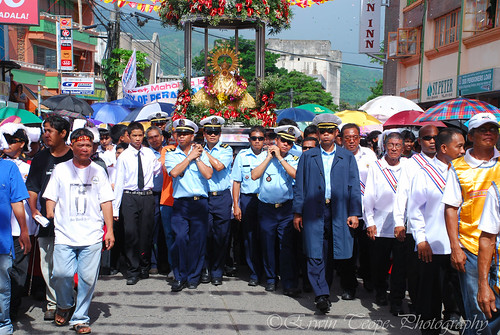
Procession in the PhilippinesThe original image of Our Lady of Peñafrancia was found by a French hermit named Simon Vela in “Peña de Francia” (rocky mountain along the Via Frances) in the village of San Martin de Castañar, Salamanca, Spain in the year 1434. The hermit, born on 1401 in the city of Paris, France, from a well off family, gave all the properties he inherited from his family and decided to live a celibate life dedicated to the Lady and serving in a Franciscan convent in the city.

During his meditations, the Lady appeared to her many times, sending him to Peña de Francia, a place unknown to him, to search for the image of the Lady. After a long and arduous journey from Paris, France to Salamanca, Spain, and only after some heartbreaking experiences and conquered hopelessness he did finally find the image of the Lady in the said rocky mountain. The devotion to the image then began there in Peña de Francia, a mountainous region between two Spanish provinces of Salamanca and Caceres.
Our Lady of Peñafrancia and devotees at Virac church.


From that village of San Martin de Castañar where Peña de Francia is located, the family of Fr. Miguel Robles de Covarubbias originated. His parents migrated in 17th century to Manila where Fr. Miguel took his religious and priestly formation under the tutelage of the Dominicans. From the cover picture of his book of devotion to the Lady, he asked a local sculptor to copy the picture by carving a statue of the Lady and put it in a new shrine made of straws and local materials in the place where the present Basilica of the Peñafrancia is located.

The Holy Image was canonically crowned and declared as Patroness of Nueva Caceres and the Bicol Region on September 2, 1924. The feast of the Lady was transferred from the first Sunday of July to the third Sunday of September. The feast is usually preceded by a Traslacion, the procession of the image from Basilica to Naga Cathedral, and then the novena masses and followed by a fluvial procession of the image from the Cathedral back to her Basilica. Today, the devotion to Ina has grown not only region-wide but also worldwide that the city of Naga becomes overcrowded by devotees and tourists during the whole Peñafrancia festival.

Written by Rev. Fr. Orly Mendoza

Competition Law in the Philippines

To date, the Philippines do not have a comprehensive and developed legislation relating to anti-trust and monopoly activities. However, there are several anti-trust bills pending before the Philippine Congress. They are as follows:

  1. Senate Bill (“S.B.”) No. 175 - An Act creating the Fair Trade Commission, prescribing its powers and functions in regulating trade competition, and monopolies and for other purposes;
  2. S.B. No. 1361 - An Act providing for more effective implementation of the Constitutional mandate against monopolies, combination and restraint of trade and unfair competition by redefining and strengthening existing laws, processes and structure regulating the same, and for other purposes;
  3. S.B. No. 1600 - An Act prohibiting monopolies, attempt to monopolize industry or line of commerce, manipulation of prices of commodities, asset acquisition and interlocking membership in the board of directors of competing corporate bodies and price discrimination among customers, providing penalties therefore, and for other purposes;
  4. House Bill (“H.B.”) 1906 - An Act declaring unfair trade practices as acts of economic sabotage. HB 1906 declares the following acts as economic sabotage and provides criminal sanctions for the same: (i) smuggling; (ii) technical smuggling; (iii) misclassification of importation; (iv) dumping, and (v) other forms of unfair trade practices.
  5. H.B. No. 198 - An Act creating a special body that shall regulate and exercise authority over monopolistic practices, combination in restraint of trade and unfair competition and appropriating funds therefore; and
  6. H.B. No. 2439 - An Act penalizing unfair trade practices and combinations in restraint of trade, creating the Fair Trade Commission, appropriating funds therefore, and for other purposes.
The most significant of these bills is S.B. No. 175, proposing the passage of the “Fair Trade Act” or an Act Creating the Fair Trade Commission, Prescribing Its Powers and Functions in Regulating Trade Competition and Monopolies and For Other Purposes. This bill consolidates all anti-trust laws into one law and establishes a Fair Trade Commission (“Commission”), an executive body that will enforce the Fair Trade Act. Generally, the bill seeks to prohibit monopolies and cartels and other practices which diminish, impair or prevent competition and free trade. It defines absolute monopolies, relative monopolies and trusts which may constitute prima facie violations of the law. A trust is defined as a merger, acquisition of control or any act whereby companies, partnerships, shares, equity, trusts or assets are concentrated among competitors, suppliers, customers or any other business entity. Under enumerated circumstances, the bill, if passed into law would require prior notification to the Commission before trusts are formed.

There are also laws of general application that are relevant to the regulation of anti-trust and monopoly activities.

The Philippine Constitution outlines the state policy of regulating or prohibiting monopolies when the public interest so requires. No combinations in restraint of trade or unfair competition are to be allowed.

In relation to this policy, the Revised Penal Code of the Philippines penalizes parties entering into any contract or agreement or taking part in any conspiracy or combination in the form of a trust or otherwise, in restraint of trade or commerce, as well as penalizes those who prevent, by artificial means, free competition in the market. It also imposes penalties on parties who monopolize any merchandise or object of trade or commerce, or who combine with any other persons to monopolize said merchandise or object in order to alter the prices thereof or who spread false rumors or make use of any other artifice to restrain free competition in the market.

The Civil Code allows the recovery of damages in cases of unfair competition in agricultural, commercial or industrial enterprises. There are also other laws on unfair competition pertaining to the protection of intellectual property rights.

RELATED LINKS:

Tuesday, February 17, 2009

Definitely Not A Mining Endorsement

Coal is not only the mineral found on our island, we too also have an ample supply of guano (pls. view the table below). Guano manure is an effective fertilizer and soil that is deficient in organic matter can be made more productive by addition of this manure.

These organic mineral can be a good alternative for our costly chemical fertilizers sourced from outside of the island. And definitely, it would mean a cost saving for our province's financial hemorrhage by making our agricultural sector self-sustaining. A bountiful harvest would equate a lower cost on our food budget.

MUNICIPALITY/
Barangay
Mineral Commodity
Estimated
Reserved
(in MT)
VIRAC
Tablora
Guano
Phospate
962
354
Calatagan
Guano
Phospate
196
72
TalisoyGuano
Phospate
1,486
583
Eli Manganese 79.50
CacaoGuano
Phospate
670
300
MarilimaGuano
Phospate
3,694
1,424
Bigaa Limestone147,000,000
Calatagan Limestone/Shale36,000,000
BAGAMANOC
Bacac
Bagatabao
Minaili
Poblacion
Iron 63,000
BATO
Sipi
Marble 40,000,000 cu.m geological reserve
6,000,000 cu.m. mineable reserve
Marinawa Manganese2,000
SAN ANDRES
Datag
Manganese 500
Carawat
Manganese 800
Codon Marble 66,666,666 cu. m. geological reserve
10,000,000 cu. m mineable reserve
Catagbacan Marble16,763,409 cu. m. geological reserve
2,514,511 cu. m. mineable reserve
J. M. Alberto
Guano
Phospate
465
183
LictinGuano
Phospate
1,601
589
Manamrag Cement Raw Materials
257,000,000
HilawanCement Raw Materials 370,000,000
Barinay
Tibang
Cement Raw Materials2,880,000
SAN MIGUEL
Boton
White Clay
3,600

source: Mineral Resources of Bicol Region, August 1990 & technical report on the Banner Mineral, Commodity Program: Marble, Nov. 1994 by Vnarido, Gapuya & JMS Laud.

RELATED LINKS:
google-site-verification: googlea4d68ed16ed2eea6.html